Wow, I'm posting a lot more often than normal! I guess you can thank my new job at Linden Lab for that. :) We'll see how long this keeps up...
As far as I can tell, there are two types of games that people play for a long time: games that water down content and stretch it out through RPG grinding or FarmVille-style appointment systems, and games where you create. Okay, I guess there's a third - games with evergreen content complexity, like Triple Town, but these are very rare and I don't know of any very successful online games based on that principle.
World of Warcraft is the obvious example for games with lots of content, and even when it's watered down there is still a ton of it and it's very expensive to develop. FarmVille is an example that combines a thin layer of grinding with a thin layer of creativity. Minecraft is an example that combines a layer of grinding (harvesting resources) with a much deeper system of creation.
In all of these examples there is a social element as well, which is essential (even in Minecraft, minimal as it is), but even non-games have it (chat clients, forums, social networking sites) so I won't dwell on it here. Just keep in mind that the longest-lasting games tend to be social in some way.
In games with a creative element, like FarmVille and Minecraft, the grinding gameplay serves to give structure and ease the player into the creative play. As the player begins to tire of the grinding gameplay, the creative part is there to take up the slack. But the initial gameplay structure is essential to provide that hook and that ramp into the later experience.
In games where the creation experience is separate from the gameplay experience, there will be some players who only do creation and many more who only do gameplay. In this case you could set it up so the creators are providing gameplay content to the players. However, without watering the content down (with grinding), it is likely that the players will burn through content much faster than creators can create it. And because playing is separate from creation, most players who burn through gameplay will not transition to creation - they'll just leave.
I've imagined making a game where you create platformer levels like in N or Super Meat Boy, and earn points when other people play these levels and rate them highly. I still think that would be a cool idea, but I'm realizing that it would not work very well as an ongoing community experience. I doubt that anyone would spend months playing Super Meat Boy, as good as it is, while millions of people play games like FarmVille or World of Warcraft for a very long time. There's just not enough gameplay in a platformer to keep people going on level design alone.
But you could imagine a game where people create watery RPG content for other people, and where the creation and gameplay aspects are connected enough that there is a steady flow of players becoming creators. If you connect the creation and gameplay in a sloppy way, the two could collapse into each other, with people exploiting creation to farm gameplay progression (creating easy dungeons with gold everywhere and no monsters, for example). There could also be problems with finding appropriate content for players at various levels. But it should be possible to tune everything so it works as a self-sustaining ecosystem of playing and creating and moving between the two.
What would that look like?
Showing posts with label metaverse. Show all posts
2013/02/06
2013/01/21
My Second Life in San Francisco
Guess what? I moved to San Francisco.
I got a new job, at Linden Lab.
This is the first time I've been living entirely on my own, in my own apartment. I have to say, it's pretty nice. Let me show you!
I've been here for over two weeks now. My first challenge has been acquiring and cooking food. While I have a lot of experience making delicious salads, I can't say I've ever really had to manage the logistics of keeping a refrigerator and pantry stocked, and rarely had to take raw meat or grains and turn them into something edible. Fortunately, it's not that hard! And as long as I add enough olive oil and balsamic vinegar and nutritional yeast, pretty much anything tastes good. ;)
I really like having the kitchen all to myself. It's a lot easier to learn to cook when I only have to worry about feeding myself and cleaning up after my own messes. I've been reading about the science behind food and cooking, and starting simple without recipes so I can understand the principles and learn to improvise from the very beginning. Also started reading The 4-Hour Chef, which is maybe more than I need right now, but it's fun and it will be a good guide as I start reaching beyond the basics. :)

I haven't tried doing much more than feeding myself, other than going to my new job - no new (or old) projects or martial arts yet. But I'm planning on going to the Global Game Jam here in the city next weekend, and hopefully that will be a good chance to meet some indie-minded game developers and make some new friends. :) I've already met a number of kindred spirits at Linden Lab (even someone who had tweeted about The Love Letter when I released it last year!) and everyone there has been really friendly and often interesting.
In fact, I've been surprised to find how much Linden Lab's focus - making "shared creative spaces" - really resonates with me. Linden Lab is not quite a game company, and I'm not quite a "gamer" - what I really love is creating things and exploring worlds and sharing with other people. Turns out that's pretty much exactly what Linden Lab is about. I'm right in their target market.
So I'm realizing that I have this really unique opportunity here, to influence what sort of new projects this big company, with all its resources, will try next. Will this be chance to see my dream game (or world?) get made, as a player, and also explore some of the avenues I am most excited about as a developer?
Maybe! I'll try not to get my hopes up, too much. :p
I'll be over here, posting on the internal Linden Lab forum with all my crazy ideas. We'll see if anyone pays attention to me...
Update:
You can now check out this photo tour on dio too!
I got a new job, at Linden Lab.
This is the first time I've been living entirely on my own, in my own apartment. I have to say, it's pretty nice. Let me show you!
Welcome to my apartment! Here, I'll take you to the living room.
There's plenty of light, with the windows facing east.
Here are some tables and my laptop desk and ball chair.
There's even a tree! Also you can see my wireless router.
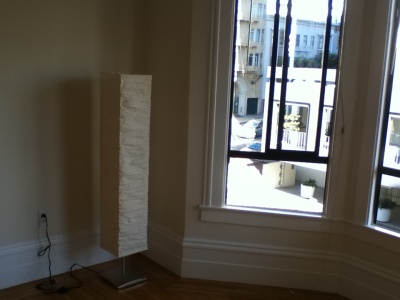
Lots of apartment buildings nearby. Also the only lamp I use.
And here's my futon, all folded up. The closet is on the right.
Some clothes and stuff on the closet shelves.
On the right side are my musical instruments.
Onward to the bathroom. Small but it works.
To the right we see... Towels! And soap. And a waste basket.
Stuff I use goes behind the mirror. The rest is under the sink.
To the left we see the entrance, and the kitchen.
The kitchen! With a folding table and chair for quick meals.
My cleaning station, on the right. Who needs a dishwasher?
Dishes above the sink. But usually I just use the drying rack.
The stove and oven, on the left. And a water filter.
Cooking supplies above the stove. Olive oil and balsamic vinegar!
Potholders, strainer, salad spinner, mixing bowls, on the left.
Pots and pans, cutting boards, knives, utensils on the right.
The microwave! And chips, and pineapple, and applesauce.
Finally, the fridge, and the freezer with meat and berries.
I've been here for over two weeks now. My first challenge has been acquiring and cooking food. While I have a lot of experience making delicious salads, I can't say I've ever really had to manage the logistics of keeping a refrigerator and pantry stocked, and rarely had to take raw meat or grains and turn them into something edible. Fortunately, it's not that hard! And as long as I add enough olive oil and balsamic vinegar and nutritional yeast, pretty much anything tastes good. ;)
I really like having the kitchen all to myself. It's a lot easier to learn to cook when I only have to worry about feeding myself and cleaning up after my own messes. I've been reading about the science behind food and cooking, and starting simple without recipes so I can understand the principles and learn to improvise from the very beginning. Also started reading The 4-Hour Chef, which is maybe more than I need right now, but it's fun and it will be a good guide as I start reaching beyond the basics. :)
I haven't tried doing much more than feeding myself, other than going to my new job - no new (or old) projects or martial arts yet. But I'm planning on going to the Global Game Jam here in the city next weekend, and hopefully that will be a good chance to meet some indie-minded game developers and make some new friends. :) I've already met a number of kindred spirits at Linden Lab (even someone who had tweeted about The Love Letter when I released it last year!) and everyone there has been really friendly and often interesting.
In fact, I've been surprised to find how much Linden Lab's focus - making "shared creative spaces" - really resonates with me. Linden Lab is not quite a game company, and I'm not quite a "gamer" - what I really love is creating things and exploring worlds and sharing with other people. Turns out that's pretty much exactly what Linden Lab is about. I'm right in their target market.
So I'm realizing that I have this really unique opportunity here, to influence what sort of new projects this big company, with all its resources, will try next. Will this be chance to see my dream game (or world?) get made, as a player, and also explore some of the avenues I am most excited about as a developer?
Maybe! I'll try not to get my hopes up, too much. :p
I'll be over here, posting on the internal Linden Lab forum with all my crazy ideas. We'll see if anyone pays attention to me...
Update:
You can now check out this photo tour on dio too!
2009/03/11
Instant AI - Just Add People
Even today, in the age of the Wii, video games still have a predominantly male image. To explain this historic lack of games that appeal to girls, many people point to the extremely high complexity of social or emotional systems compared to the movement of objects and projectiles. Making Space Invaders is a lot easier than making an interactive adaptation of Pride and Prejudice.This may be true, but this complexity gap need not stop us any longer. Why bother simulating any social or emotional nuances when real live humans are so easy to co-opt into willing participants in a social space facilitated by web technology? Don't waste your time writing advanced AI, just use people.
Say you have some item, like a virtual item in a game. If you are making a social game, you might be tempted to try directly specifying its effects on a player's social network. This would be hard to do effectively. But if instead you structure your players' social interaction and communication to meaningfully involve and be affected by this virtual item, these players will construct a much more nuanced meaning for it themselves. There is no need to abstract it away.
Provide opportunities for the players to create significance themselves out of the elements you provide. Come to think of it, this approach can even apply outside of social games, sort of like how Tale of Tales would like to see more games as instruments.
Now I think that abstracted formal simulations of social dynamics have their place, particularly for educational purposes or to illustrate a certain point. But I wonder if either of these goals might still be compatible with the structured socialization approach, using real players. It's an interesting idea. How far can you go in simplifying these interactions and dynamics before people are unable or unwilling to play in your world?
*image from the excessively cute and catchy Less Than Three*
2007/10/24
MySpace, Miis, Motivation
Just as some background so you can see why I'm talking about this, I've done a bit of work trying to teach game programming to kids - teenagers, really - and it's not easy. Thinking of how to make education more effective is a consideration that's often in the back of my mind.
I think that if you want to motivate kids to work on creating games, or anything else really, it's essential to give the project meaning by having them publish their creations where their peers can see.
Social networking sites like MySpace are very popular - you might even say a ubiquitous phenomenon in schools (just my own observation) - and help provide meaning and motivation for other activities. So if a project fulfills a role in that social context, the kids will be happy to do it. If it will make them more popular, or special, or somehow feels like an accomplishment within the metagame of a social networking site, then they'll want to do it. Otherwise, it's just work.
Reading the excellent Miniature Gardens & Magic Crayons again, I realized that games like The Sims, as well as Nintendo's Mii Channel, might be compelling to non-gamers partly because they can be used to explore and make statements about social networks. Both the virtual doll house game The Sims and the feature of the Nintendo Wii that allows one to recreate people's likenesses as virtual Mii dolls are appealing to people who don't normally play video games. I would guess that these people are not playing for the same reasons that typical gamers do. Instead I imagine that for the average person, creating and playing with representations of their friends (or enemies, or celebrities, or whatever) is an activity motivated by social concerns - a subset of those activities involved with socializing, exploring where one stands in relation to other people, and making statements about how one views these relationships. The fact that these are video games is almost irrelevant
The game industry is very used to thinking about things in terms of games - game reviewers for the most part agree on what makes a good game, and they all basically think about games in the same way. But that way is not going to help them think about why people like The Sims or the Wii.
Fortunately, a few people are thinking differently, and the creators of Habbo Hotel are a good example. I'd really recommend reading this report of Sulka Haro's keynote about Habbo Hotel - I found it very interesting and inspiring. There was one quote in particular I found very interesting, about the fact that tons of the mostly-teenage players of Habbo Hotel spend their time playing make-believe, roleplaying activities and roles that the game itself doesn't support: "If you look, little kids will play for hours... but teenagers are reaching the age where that's not socially allowed anymore. We're providing an environment where that's OK."
As an example given by the article, there are people who pretend to be horses, and then other people pretend to pet them! That's crazy, I don't even know how that would work! But apparently people do it. And another thing that was mentioned was how the players are often very concerned with keeping Habbo Hotel a private place separate from their parents - it would be too embarrassing otherwise, I imagine. Again, my mind is flashing back to Miniature Gardens.
Well, I seem to have drifted far from my original topic, which was about how to motivate kids to work on projects in an educational context. But this is all good stuff, and I would have wanted to get to it in a blog post sooner or later. I don't really have any conclusions to make at this point, so consider this food for thought.
And about the one-blog-post-a-week thing, I've just been so busy with school that I can't spare the time, seriously. It has turned out to be more difficult than I expected to turn my quick notebook entries into interesting, coherent blog posts. I'll keep trying though. Thanks for reading.
I think that if you want to motivate kids to work on creating games, or anything else really, it's essential to give the project meaning by having them publish their creations where their peers can see.
Social networking sites like MySpace are very popular - you might even say a ubiquitous phenomenon in schools (just my own observation) - and help provide meaning and motivation for other activities. So if a project fulfills a role in that social context, the kids will be happy to do it. If it will make them more popular, or special, or somehow feels like an accomplishment within the metagame of a social networking site, then they'll want to do it. Otherwise, it's just work.
Reading the excellent Miniature Gardens & Magic Crayons again, I realized that games like The Sims, as well as Nintendo's Mii Channel, might be compelling to non-gamers partly because they can be used to explore and make statements about social networks. Both the virtual doll house game The Sims and the feature of the Nintendo Wii that allows one to recreate people's likenesses as virtual Mii dolls are appealing to people who don't normally play video games. I would guess that these people are not playing for the same reasons that typical gamers do. Instead I imagine that for the average person, creating and playing with representations of their friends (or enemies, or celebrities, or whatever) is an activity motivated by social concerns - a subset of those activities involved with socializing, exploring where one stands in relation to other people, and making statements about how one views these relationships. The fact that these are video games is almost irrelevant
The game industry is very used to thinking about things in terms of games - game reviewers for the most part agree on what makes a good game, and they all basically think about games in the same way. But that way is not going to help them think about why people like The Sims or the Wii.
Fortunately, a few people are thinking differently, and the creators of Habbo Hotel are a good example. I'd really recommend reading this report of Sulka Haro's keynote about Habbo Hotel - I found it very interesting and inspiring. There was one quote in particular I found very interesting, about the fact that tons of the mostly-teenage players of Habbo Hotel spend their time playing make-believe, roleplaying activities and roles that the game itself doesn't support: "If you look, little kids will play for hours... but teenagers are reaching the age where that's not socially allowed anymore. We're providing an environment where that's OK."
As an example given by the article, there are people who pretend to be horses, and then other people pretend to pet them! That's crazy, I don't even know how that would work! But apparently people do it. And another thing that was mentioned was how the players are often very concerned with keeping Habbo Hotel a private place separate from their parents - it would be too embarrassing otherwise, I imagine. Again, my mind is flashing back to Miniature Gardens.
Well, I seem to have drifted far from my original topic, which was about how to motivate kids to work on projects in an educational context. But this is all good stuff, and I would have wanted to get to it in a blog post sooner or later. I don't really have any conclusions to make at this point, so consider this food for thought.
And about the one-blog-post-a-week thing, I've just been so busy with school that I can't spare the time, seriously. It has turned out to be more difficult than I expected to turn my quick notebook entries into interesting, coherent blog posts. I'll keep trying though. Thanks for reading.
Related:
metaverse,
motivation,
play
2006/11/28
Second Life Discussions
I've just been reading a very interesting discussion about a recent occurence in Second Life that is threatening to completely change the nature of SL's economy. It has many reflections onto real life issues.
On another note, I just came across a nice and unexpected little insight on Torley's blog.
Related:
metaverse
2006/10/12
Reaction to True Names
I recently read a short story by Vernor Vinge called True Names. Apparently this book was the first to introduce the concept of virtual reality! There are some better-known books inspired by this one, like Neuromancer and Snow Crash, but I have to say that I liked True Names much more.
I found the book to be very engaging and inspiring. My favorite part I think would be the description of what the book calls the "Other Plane" which is better known as the Metaverse or the Matrix, basically a big virtual world that people connect to. I love how it compares the sensation to that of reading a book - it made me reflect back on my own experience as I read it:
"A typical Portal link was around fifty thousand baud, far narrower than even a flat video channel. Mr. Slippery could feel the damp seeping through his leather boots, could feel the sweat starting on his skin even in the cold air, but this was the response of Mr. Slippery's imagination and subconscious to the cues that were actually being presented through the Portal's electrodes. The interpretation could not be arbitrary or he would be dumped back to reality and could never find the Coven; to the traveler on the Other Plane, the detail was there as long as the cues were there. And there is nothing new about this situation. Even a poor writer - if he has a sympathetic reader and an engaging plot - can evoke complete internal imagery with a few dozen words of description. The difference now is that the imagery has interactive significance, just as sensations in the real world do. Ultimately, the magic jargon was perhaps the closest fit in the vocabulary of millenium Man."
There were a few other little enjoyable descriptions:
"Pollack...could make it simply by staring out into the trees and listening to the wind-surf that swept through their upper branches. And just as a day dreamer forgets his actual surroundings and sees other realities, so Pollack drifted, detached..."
Isn't that a nice visualization?
I also liked how it was similar to my own idea of using music to represent an extrasensory perception of magical fields in a game. Now from reading True Names I can imagine it would be so cool to be able to stimulate such daydream-like experiences with only sound. Then my eyes wouldn't get tired by staring at a screen! And I just love this line, "The difference now is that the imagery has interactive significance, just as sensations in the real world do." Wow, trying to daydream as from a book, yet also interact with the world you are constructing? That would be an amazing experience.
And of course it was nice that this story used fantasy and magic as the environment for its "Other Plane" instead of the cyberpunk of Neuromancer and Snow Crash. I guess I just find it a little more inspiring. I'm not really into gritty, dark settings.
The story also felt so much more epic than the other books; I thought it was more like The Matrix in its feel. Maybe that's because of the god-like powers the protagonists experience in both, while at the same time you are aware of the frailty of their bodies in the physical world. Plus the "bad guys" were a little more direct and personified, once you find out who they are. :p (plus I'd bet that the Oracle scene in The Matrix was based on the end of True Names)
Another reason why it felt epic was how the ending kind of put the story onto a timescale of thousands of years, as a special moment in humanity's history. It reminded me of the ending of Ender's Game in its vague pointing towards the future.
So, basically, go and read it!
I found the book to be very engaging and inspiring. My favorite part I think would be the description of what the book calls the "Other Plane" which is better known as the Metaverse or the Matrix, basically a big virtual world that people connect to. I love how it compares the sensation to that of reading a book - it made me reflect back on my own experience as I read it:
"A typical Portal link was around fifty thousand baud, far narrower than even a flat video channel. Mr. Slippery could feel the damp seeping through his leather boots, could feel the sweat starting on his skin even in the cold air, but this was the response of Mr. Slippery's imagination and subconscious to the cues that were actually being presented through the Portal's electrodes. The interpretation could not be arbitrary or he would be dumped back to reality and could never find the Coven; to the traveler on the Other Plane, the detail was there as long as the cues were there. And there is nothing new about this situation. Even a poor writer - if he has a sympathetic reader and an engaging plot - can evoke complete internal imagery with a few dozen words of description. The difference now is that the imagery has interactive significance, just as sensations in the real world do. Ultimately, the magic jargon was perhaps the closest fit in the vocabulary of millenium Man."
There were a few other little enjoyable descriptions:
"Pollack...could make it simply by staring out into the trees and listening to the wind-surf that swept through their upper branches. And just as a day dreamer forgets his actual surroundings and sees other realities, so Pollack drifted, detached..."
Isn't that a nice visualization?
I also liked how it was similar to my own idea of using music to represent an extrasensory perception of magical fields in a game. Now from reading True Names I can imagine it would be so cool to be able to stimulate such daydream-like experiences with only sound. Then my eyes wouldn't get tired by staring at a screen! And I just love this line, "The difference now is that the imagery has interactive significance, just as sensations in the real world do." Wow, trying to daydream as from a book, yet also interact with the world you are constructing? That would be an amazing experience.
And of course it was nice that this story used fantasy and magic as the environment for its "Other Plane" instead of the cyberpunk of Neuromancer and Snow Crash. I guess I just find it a little more inspiring. I'm not really into gritty, dark settings.
The story also felt so much more epic than the other books; I thought it was more like The Matrix in its feel. Maybe that's because of the god-like powers the protagonists experience in both, while at the same time you are aware of the frailty of their bodies in the physical world. Plus the "bad guys" were a little more direct and personified, once you find out who they are. :p (plus I'd bet that the Oracle scene in The Matrix was based on the end of True Names)
Another reason why it felt epic was how the ending kind of put the story onto a timescale of thousands of years, as a special moment in humanity's history. It reminded me of the ending of Ender's Game in its vague pointing towards the future.
So, basically, go and read it!
Related:
book,
metaverse,
perception
2006/09/18
The Endless Forest
One IGF entrant I was surprised to see on the list was an experimental MMO called The Endless Forest. I first found out about it last year, but it was too weird for me. But now it seems to have acquired a stable following of seemingly sane fans, so I am giving it a second chance.
Basically it's a game where you are a magical stag with a human-ish face, with a glowy pictogram between your antlers that serves to differentiate you from the other players. You walk around in a mysterious forest, where you may find other deer to play with. There is no chat though - all communication must be done with body language.
There's some weirder stuff too. Apparently there exist "pagan souls" that you can convert to Christianity by touching them. At the end of the day pagan souls turn into pagan idols while Christian souls turn into gravestones with crosses on them. Not only that but there are plans to add computer-controlled female deer with which you must mate.
So naturally I suspected that it was part of an evil plan to brainwash players into joining some sort of strange and dangerous cult. :p However, after reading through the forums, which are full of innocent discussion among players, as well as friendly and sane responses by the developers, some of my initial suspicion has been lifted. I have even downloaded the game and created an account!
(to be continued...)
Basically it's a game where you are a magical stag with a human-ish face, with a glowy pictogram between your antlers that serves to differentiate you from the other players. You walk around in a mysterious forest, where you may find other deer to play with. There is no chat though - all communication must be done with body language.
There's some weirder stuff too. Apparently there exist "pagan souls" that you can convert to Christianity by touching them. At the end of the day pagan souls turn into pagan idols while Christian souls turn into gravestones with crosses on them. Not only that but there are plans to add computer-controlled female deer with which you must mate.
So naturally I suspected that it was part of an evil plan to brainwash players into joining some sort of strange and dangerous cult. :p However, after reading through the forums, which are full of innocent discussion among players, as well as friendly and sane responses by the developers, some of my initial suspicion has been lifted. I have even downloaded the game and created an account!
(to be continued...)
Subscribe to:
Posts (Atom)